Co-operative AI Infrastructure for Canada’s Solidarity Economy
A Feasibility Study
Co-operative AI Infrastructure for Canada’s Solidarity Economy
Reclaim Your Data. Own Your Stack.Values.Wisdom.Future.
Can Canadian co-operatives compete against the huge corporations running Artificial Intelligence (AI) for most of the world?
The short answer: yes — and the sector has more to lose by waiting than by acting now.
Our team surveyed co-operatives and solidarity organisations to determine the how people are using AI tools. Then we researched the feasibility of self-hosted alternatives.
The results were concerning and also encouraging.



This study underscores a pivotal moment for Canada’s co‑operative and mutual sector. Co‑operatives are actively using AI tools today, yet much of that activity is occurring outside of frameworks that safeguard data, privacy, and sovereignty. This feasibility study shows that we have a credible path forward: a co‑operative, Canadian-owned approach to AI infrastructure. By working together, we can build shared, trusted systems that protect our data, strengthen our organisations, and reinforce the principles of democratic control in the digital economy.
 John Kay, President, Co-operatives and Mutuals Canada
The Solidarity Stack
Our feasibility study concluded that we have alternatives to the big corporate solutions, but we’ll need to work together.

For worker co-operatives, controlling the tools of production has always been fundamental. This study proves that in the digital age, that must include owning our data and our intelligence infrastructure, to the extent it is possible in the time of billionaires and rapidly increasing instability for workers – much of it caused by AI. The Solidarity Stack offers a clear roadmap to protect worker autonomy, helping to ensure that artificial intelligence could be used to empower democratic workplaces rather than centralize power in corporations.
 Hazel Corcoran, Executive Director, Canadian Worker Co-operative Federation
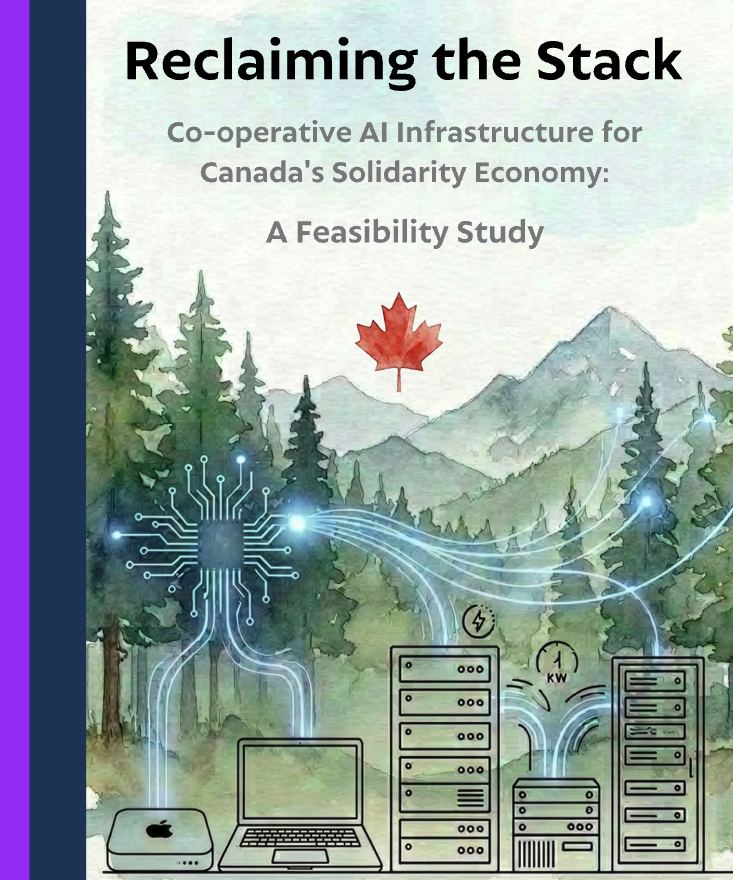
Reclaiming the Stack: Co-operative AI Infrastructure for Canada’s Solidarity Economy
The report was co-authored by CanTrust Hosting Co-operative and Hypha Worker Co-operative, with grant funding from The Co-operators.
The study proves that achieving a values-aligned AI ecosystem is not only technically feasible but financially viable if sector leaders pool their resources.
The authors are calling upon Canadian co-operative federations, credit unions, and social financiers to actively back and fund the development of this shared infrastructure.
Hypha and CanTrust’s report moves the discussion about AI and cooperatives to infrastructure and governance. At a moment of growing dependence on Big Tech, this is a concrete contribution to building democratic digital infrastructure. What excites me most about this feasibility study is that it asks the right questions. It’s not solely about whether co-ops can use AI, but whether they can collectively own and govern the stack itself; from the soil to the cloud.
 Trebor Scholz, Founding Director, Platform Cooperativism Consortium / The New School
About the Authors

CanTrust Hosting Co-op is a member-owned, triple-bottom-line (people, planet, and profit) information technology enterprise.

Hypha is a co-operative because we believe it changes the equation: long-term relationships over quick wins, quality over moving fast and breaking things.